
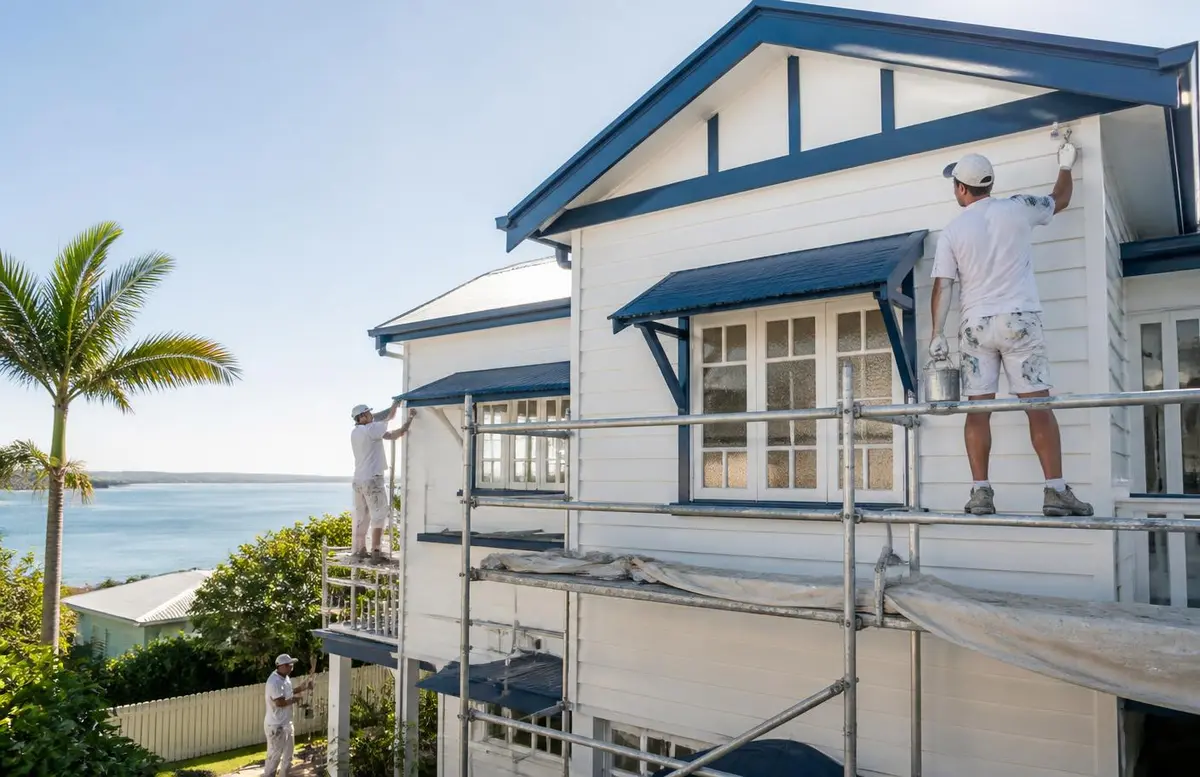
A question we hear constantly from Geelong homeowners, from Newtown to Ocean Grove, is whether a tired-looking house genuinely needs a full repaint or whether a targeted touch-up will do the job. The right answer hinges on whether what you are seeing is a contained, one-off problem or a broader sign that the coating system itself is worn out. Get it wrong and you either spend on a repaint the house didn't need, or you keep patching a surface that will keep failing. Here is how we work out which is which.
Contained damage versus a coating that has run its course
Contained damage has a clear, single cause: a downpipe that has been overflowing onto one section of weatherboard, a hose reel that has scuffed a patch of render, or a garden bed splashing mulch and soil against a low fence line. A coating that has run its course looks different — the wear shows up broadly across an elevation, or the whole house, and points to the paint film itself failing rather than one isolated event.
In Geelong's cool-temperate climate, this broader failure often plays out differently depending on aspect. North and west walls in suburbs like Highton and Grovedale cop hot, dry summer sun and wide daily temperature swings that dry out and crack paint film over time, while shaded southern walls on established Newtown and Belmont homes stay damp through winter and develop mould and lichen instead. If cracking, chalking or fading is spread across most of the house rather than one damaged patch, you are looking at a full repaint, not a touch-up.
Signs a spot repair will do
- One water mark or bubble traced to a fixable cause, such as a downpipe joint that has since been repaired
- Fresh knocks or scrapes from moving furniture, bikes or a trailer against a wall
- Isolated hairline cracking in an otherwise firm, well-bonded coating
- Grime or fading confined to a shaded corner rather than spread across the whole wall
Signs you need a full repaint
- Chalking, where a powdery residue rubs off on your hand, across most of a wall or the whole house
- Cracking or flaking turning up in several unrelated spots at once
- Noticeable colour fade on north and west elevations that take the brunt of summer sun
- Failure across different materials at once — timber trim, render and fascia all showing problems together
- An old coating system that has generally lost its grip on the surface
Testing adhesion before deciding either way
Before we recommend a touch-up or a repaint, we check how firmly the existing paint is actually holding to the surface. A house can look worn from the street but still have a sound base coat needing only a wash and fresh top coat — or it can look presentable but be barely clinging on underneath.
Running a cross-hatch check
A cross-hatch check involves scoring a small grid of shallow cuts into the paint in a hidden spot, then pressing on and pulling off a strip of tape across the grid. If squares of paint lift away with the tape, adhesion has already failed, and any fresh coat over the top will fail with it no matter how good the new paint is. If the grid stays put, the existing film is a workable base to build on.
Coating over a surface with poor adhesion is one of the most common reasons a new paint job fails early. No premium product fixes a bond problem underneath it — the surface has to be sound, or made sound, before new paint goes on.
Why matching colour on a touch-up is harder than it sounds
Even where a touch-up makes structural sense, there is a separate hurdle: will it blend in? Paint fades under sun exposure, and a can of the same colour applied years later will often read brighter, flatter or slightly off-tone next to the sun-faded wall around it. This shows up most on darker colours and on walls copping direct afternoon sun, which in Geelong tends to mean west-facing walls across Belmont and Waurn Ponds.
Watch for sheen flashing
Sheen flashing happens when a patched area reflects light differently to the surrounding paint, either because the new film has a different gloss level or because the old surface has weathered to a flatter finish over time. Under low winter light along a street in Torquay or Barwon Heads, a poorly matched touch-up can stand out more than the damage it was meant to cover.
- Touch-ups blend best on lighter, low-sheen colours in shaded spots
- Touch-ups are most obvious on dark, glossier colours in direct sun
- Feathering the edges and cutting in at a natural break, like a corner or joint, helps disguise the repair
- A small test patch somewhere inconspicuous is worth doing before committing
Weighing up the cost logic, without quoting figures
We won't put numbers on this, but the underlying logic holds up regardless of price. Spot repairs make sense when the problem is genuinely isolated, because you are only paying for labour and materials on a small section. They stop making sense when the coating is failing broadly, because you end up paying for repeat patch jobs over a year or two that never actually solve the issue, often costing more in total than one well-staged repaint.
Preparation is the other factor. A full repaint allows a proper, coordinated wash, sand, prime and seal across the whole house. A run of individual touch-ups rarely gets the same level of preparation, since it is happening reactively, one small area at a time, which is part of why patched houses often need attention again sooner.
Staging a repaint elevation by elevation
If a full repaint is the right move but budget or timing means it has to happen in stages, splitting the job by elevation is the sensible approach. North and west walls take the heaviest UV and heat load in Geelong's dry, sun-heavy summers and generally show wear first, so they deserve priority. South-facing walls, especially shaded ones, are more prone to mould and moss from winter dampness than sun damage, and can often wait a little longer if otherwise sound.
- Stage 1 priority: north and west elevations showing the most sun fade
- Stage 2: east elevations, which get milder morning sun and moderate wear
- Stage 3: south elevations and shaded spots, usually needing mould treatment more than UV repair
- Trim, fascia and gutters can be scoped and staged separately from the main wall colour
If you're staging a repaint over time, stick to the same product line and colour batch across every stage where possible. Mixing different paint batches or ranges across elevations painted months apart is a common cause of visible colour mismatch further down the track.
When partial work is the sensible choice
Not every ageing house needs an immediate full repaint. If the home is generally sound, the existing coating passes an adhesion check, and the issues trace back to a defined, resolved cause — a downpipe that has since been fixed, a fence line scuffed during a landscaping job, a section knocked while moving a trailer — a carefully prepared, well-blended spot repair is a sensible, lower-disruption option. The key is proper preparation: cleaning, sanding the repair edges back, and correct priming wherever bare timber or render is exposed, even on a small patch.
A quick decision checklist
- Is the failure tied to one identifiable, resolved cause? → Spot repair is reasonable
- Does the cross-hatch check show good adhesion elsewhere on the house? → Spot repair is reasonable
- Is chalking, cracking or fading turning up in multiple unrelated spots? → Full repaint
- Is the existing coating over a decade old with no maintenance history? → Full repaint
- Will a colour or sheen mismatch be obvious from the street? → Consider a full elevation repaint instead of a patch
Getting a straight answer on-site
Because this call affects both the look and the lifespan of your paint job, it's worth having it assessed in person rather than guessed from a photo. We check coating condition across each elevation, run adhesion tests where needed, and give you a plain recommendation — spot repair, staged repaint or full repaint — based on what the house actually needs.
If you're staring at a tired-looking house and unsure whether it needs a touch-up or a full repaint, we're happy to come and take an honest look. Call for a free quote or send the quote form on this page to arrange an assessment.
Questions about your own property?
Call NowFor a local assessment, explore our house painting service in Geelong or ask about work in Newtown.
Request an on-site painting assessment